Why a new clinical trial unit is a milestone for BC’s life sciences sector
19 September 2025
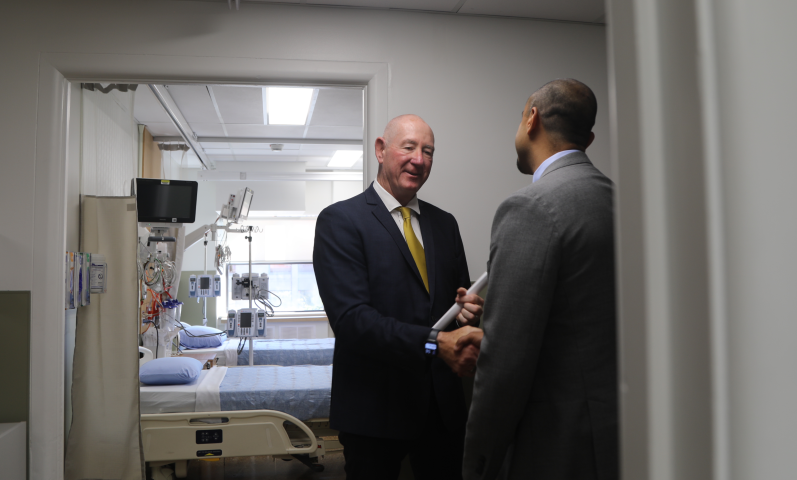
Darryl Knight, Vice President Research and Academic Affairs, Providence Health Care, shakes hands with Ravi Kahlon, BC’s Minister of Jobs and Economic Growth, at the opening of the new clinical trials unit at Mount Saint Joseph Hospital on September 16, 2025.
Clinical trials are the only way today’s discoveries become tomorrow’s medicines. They play a crucial role in evaluating new treatments and ensuring British Columbians can access better medical care.
Trials unfold in phases, the earliest of which – Phase 1 trials – test promising medicines in humans for the first time, providing critical data on safety and effectiveness.
| Before this year, BC did not have a dedicated facility to conduct Phase 1 clinical trials for anything but cancer treatments. Now, that’s changing.
Health Research BC and Clinical Trials BC are expanding Phase 1 clinical trials through a partnership with Providence Health Care to open the first healthy volunteer trial unit in the province. The new eight-bed unit opened this month at Mount Saint Joseph Hospital in Vancouver. |
Health Research BC and Clinical Trials BC partnered with Providence Health Care to open BC’s only Phase 1 clinical trial unit dedicated to non-cancer treatments. |
“Patients and the public are asking for this,” says Alison Orth, Portfolio Director, Clinical Trials BC. “Since the pandemic, there has been an increased call for action and greater demand for clinical trials. This new facility is a response to that call.”
The new unit will support efforts to keep innovation in Canada. Previously, biotechnology companies in BC had to go overseas or out-of-province to begin human trials. Now, the entire innovation cycle from laboratory to bedside can remain in BC.
“As a resident of BC, it’s frustrating to see companies start up here and then relocate their clinical operations to the US or elsewhere,” says Alison. “Once they move, the chances of them coming back are slim. We lose the economic and research opportunities they could provide.”
Keeping health research in BC benefits the economy. More trials mean more well-paying jobs and greater investment from private industry. Expanding the province’s clinical trial capacity and capabilities is part of the BC Life Sciences and Biomanufacturing Strategy.
The unit’s creation was enabled by a $4.2 million investment by the Government of B.C. Health Research BC contributed $1.2 million to further strengthen the province’s clinical trials environment, including $600,000 towards the unit and $600,000 to support a professorship at the University of British Columbia that will serve as the unit’s chief medical officer.
In addition, Clinical Trials BC is supporting the new unit in multiple ways, including regulatory compliance consultation, training, and digital platforms to support the quality and efficiency of trials based at the new unit.

The new eight-bed clinical trials unit conducts first-in-human healthy volunteer trials for new medicines.
Using technology to streamline clinical trials
Technology gaps were called out as one of BC’s infrastructure constraints in a recent analysis of the province’s clinical trials ecosystem. The report highlighted BC’s need for modern digital tools for data collection, patient monitoring, and trial management.
There are so many components to making a trial work. How do you find people to take part? How do you manage the administrative and financial tasks? How do you train staff to conduct the trials?
As BC revitalizes its life sciences sector, it is important that clinical trials take advantage of the latest tools.
Platform for participants to find trials
One of those resources is an online tool for recruiting study participants.
REACH BC is Clinical Trials BC’s online platform that matches the public with health research opportunities. Launched in 2020, it puts power in the hands of people to express interest in being involved. Researchers can connect with healthy volunteers or people with specific medical conditions for upcoming studies.
The platform also makes administration easier and enables cross-country collaboration.
More than 250 healthy participants have already expressed interest through REACH BC to be part of healthy volunteer trials.
“It’s beyond expectations,” Alison says. “Everybody is thrilled.”
Managing clinical trials
Another resource is the provincial clinical trial management system. The cloud-based platform helps with the administrative side of a trial. It can track participants, milestones, and financial data to make trials more efficient. Having a province-wide system lowers the cost per trial and allows researchers to collaborate.
Providence Health Care maintains a profile on the Canadian Clinical Trial Asset Map with Clinical Trials BC’s support. The map is a searchable web-based database where companies that initiate clinical trials can find researchers and sites with the expertise and capability to conduct their trial.
Training staff
Providence Health Care is also using Clinical Trials BC’s education resources to train the Phase 1 clinical trial unit staff. They will have the necessary skills and expertise to hit the ground running. Unit staff will use Clinical Trials BC’s quality and regulatory resources to help with consistency and compliance with rules and standards.
“Our support of the new unit takes advantage of BC’s deep life sciences expertise to improve our healthcare and keep economic activity right here in BC,” says Alison.

Danielle Lavallee, Vice President Research, Health Research BC; Anne Stevens, Vice President Business Development, AbCellera; Darryl Knight, Vice President Research and Academic Affairs, Providence Health Care; Ravi Kahlon, Minister of Jobs and Economic Growth; and Amshen (Joan Phillip), MLA for Vancouver-Strathcona at the opening of the new clinical trials unit at Mount Saint Joseph Hospital on September 16, 2025.
Learn more: