Real world experience drives real world impact
28 January 2026
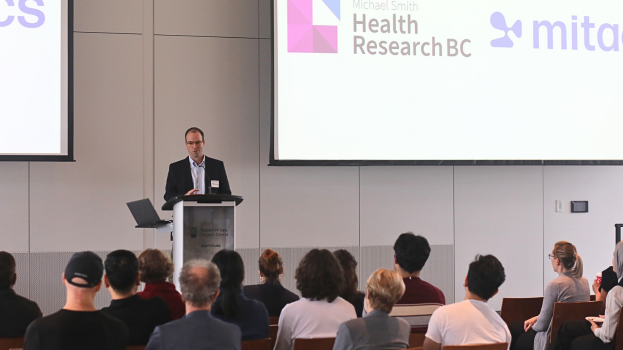
Photo: Dr. Nicholas Weilinger, Chief Scientific Officer, CereCura Nanotherapeutics, speaks at a Mitacs-Health Research BC event in October 2025.
How do research trainees working in academia gain business skills needed to grow BC’s life sciences sector? This gap is highlighted in the BC government’s Life Sciences and Biomanufacturing Strategy. One solution is providing researchers with internship opportunities in life science companies.
An $8 million partnership between Michael Smith Health Research BC, Mitacs, and BC-based life sciences companies gives emerging researchers direct access to industry experience that traditional academic routes can’t always provide.
One example is Dr. Daniel Andrews’ internship at CereCura Nanotherapeutics. CereCura is an early-stage biotech startup developing therapies for diseases of the brain, an area of medicine known for long timelines, high costs, and scientific complexity.
Now on staff at CereCura, the post-doctoral researcher is creating new medicines to help the brain make a special protein that could help treat rare brain diseases.
“Through this internship, I’ve gained valuable experience working directly with a life sciences company — experience I wouldn’t have had through academic training alone,” says Daniel. “It’s given me a clearer picture of how my research skills can contribute to innovation, and it’s helping shape the direction of my career.”
Partnership in action
The program fosters a mutually beneficial ecosystem: giving interns hands-on research and career growth, enabling post-secondary institutions to make meaningful research contributions, and allowing companies like CereCura to pursue projects that might otherwise be too difficult or costly.
“As a growing company in BC’s life sciences ecosystem, having access to talented interns is critical,” says Dr. Nicholas Weilinger, Chief Scientific Officer, CereCura Nanotherapeutics.
In today’s difficult funding environment, the biggest risk is not a lack of ideas, but the ability to sustain research long enough to translate those ideas into viable therapies. For a small team, balancing ongoing scientific progress while raising capital makes it essential to use resources wisely.
The access to outstanding talent allows the CereCura team to stay focused on advancing science and research. “This program reduces the financial barrier for companies to access research talent that fills important skills gaps and brings fresh perspectives and energy to our work,” says Nicholas.
The partnership demonstrates Health Research BC’s commitment to developing new and innovative ways to build health research talent for BC’s future while strengthening BC’s position in the global life sciences sector.