BC researchers uncover changing climate’s impact on health
25 August 2025
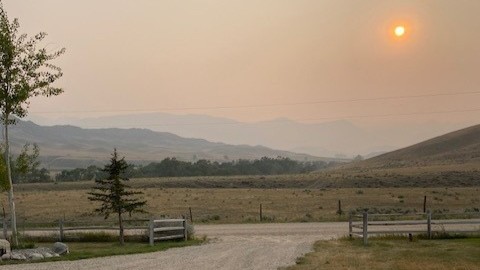
Dr. Emily Brigham took this photo of smoky skies on her move from Baltimore to Vancouver.
Summers in British Columbia are changing. A season that was once primarily pleasant can now bring wildfire smoke and extreme heat events.
Researchers in the province are measuring the impact of a changing climate on human health and figuring out how people can protect themselves.
Can a healthy diet protect us against wildfire smoke?
Dr. Emily Brigham remembers the orange sun through thick wildfire smoke during her cross-continent move to Vancouver. It convinced her she had made the right decision.
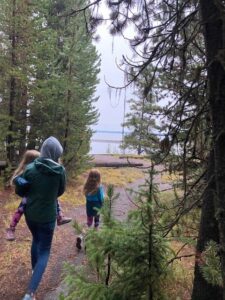
The lung specialist had just accepted a new position at the University of British Columbia (UBC) researching wildfire smoke’s impact on health. She packed her family into their vehicle and camped most nights between the East Coast of the US and BC. The smoke along the way reinforced the need for research into climate and health.
“It solidified my focus,” she says. “This is where I needed to go with my research program.”
Wildfire smoke is a growing threat to health, including for British Columbians. Alongside caring for patients with lung conditions, Emily is working with a growing team of researchers at UBC investigating how wildfire smoke affects people’s health and what actions individuals can take to stay safe.
There is already research that suggests a healthy diet could have a positive impact on people living with lung conditions like asthma or chronic obstructive pulmonary disease (COPD). Emily’s research goes a step further to see whether food is beneficial to lung health when people are exposed to wildfire smoke.
“If we give people food that has been associated with better lung health, like fruits, vegetables, and fish, can we change how the lungs react to smoke exposure?” she says.
The team is focusing on these foods because they contain antioxidants and omega-3 fatty acids that can help the body withstand and resolve inflammation.
The next step in her research is starting a clinical trial. Beginning this summer, some participants will receive prepared meals and groceries several times per week to boost their intake of lung-healthy foods. Study participants will undergo controlled exposure to woodsmoke at UBC’s Air Pollution Exposure Lab with Dr. Christopher Carlsten, Director of Vancouver Coastal Health Research Institute’s Centre for Lung Health. The team will see how different diets can impact lung resiliency.
To help design the trial, Emily and the team worked with people living with lung conditions, called patient partners. One patient partner noticed that the planned food delivery service would provide the same meal multiple times in a week. They pointed out that people may not stick to a meal plan without variety, which would affect study results. That input prompted the team to rethink the meal plans. Emily added she is grateful to the BC SUPPORT Unit and Legacy for Airway Health for helping connect the team with patient partners who improved the study design.
Another portion of Emily’s research looks at children and wildfire smoke. She and her team are analyzing existing data from a Canadian study to see if there are certain times as children grow when they are more vulnerable to smoke damage.
As part of a larger team at UBC, Emily is looking for clues about how someone’s age, genetics, and habits contribute to their risk during wildfire season. Insights could lead to interventions to reduce health risks.
A Hot Topic podcast explores 2021 heat dome’s impacts
The summer of 2021 was pivotal for Dr. Sarah Marie Wiebe. She gave birth to her son about a month before the deadly heat dome settled over the Greater Victoria area. She ended up in the emergency department, battling dehydration while struggling to nurse her newborn. Temperatures in the province soared as high as 40°C, up to 20 degrees above normal.
“I was at a total loss,” she says. “Which surprised me as a highly educated person. I didn’t know where to get good information about what was happening. It was unprecedented. I just had this feeling of coming undone.”
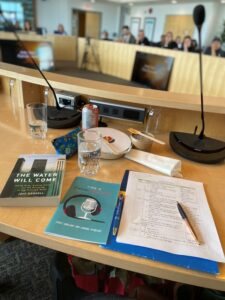
The experience motivated her to write a book about mothering through the climate emergency. When she returned to work at the University of Victoria, she decided to focus on the heat dome’s impacts on those most vulnerable.
Her team, co-led by Kirsten Mah, a Healthy Communities Planner with the Capital Regional District, conducted a study using a survey and sharing circles. They heard how seniors, newcomers, new mothers, and others in and around Victoria experienced the heat dome.
Her efforts resulted in a report and a story map. To share some of the stories, her team also created a podcast series. A Hot Topic: Addressing Heat Vulnerability in the Capital Regional District, released its first episode in June 2025. Episodes continue to be released throughout the summer.
The podcast features people living in and around Victoria, touching on the not-always-obvious heat dome impacts. Eva Shaffer, a member of and Marine Liaison for the T’Sou-ke First Nation, shares in the first episode how the salmon run was decimated months after the heat dome.
“The water got too shallow. The rivers were too low. The salmon couldn’t get up. Our count was maybe 10 fish,” Eva says. “We basically didn’t have a run that year. And any eggs that were laid were either buried or washed away when we got a month of rain in 24 hours [that November].”
Many berry species didn’t come out that year either, impacting forage harvests.
“Our territory saw a lot of stress,” Eva says. “It’s never not cooled off overnight here, in my living memory. We’re right on the ocean. We call August ‘fog-ust’ because it’s so chilly and damp. You can’t argue against climate change.”
John Lamont, a peer support worker in Victoria, remembers what the 2021 heat dome was like living in mental health subsidized housing. He recalls getting outside the building being the only way to get relief. He went to the gym and sat in a mall food court to find air conditioning.
“I was facilitating some Zoom workshops [from home] during this time. We had a 15-minute break, and I just had to sit in the tub to cool down. I got through it somehow … but somebody upstairs in our building passed away during the heat dome. It made it a little more real.”
The BC Coroners Service attributed 619 deaths to heat-related causes during the week-long heat dome.
Following support from Health Research BC for her initial investigation into the heat dome’s impacts, Sarah was approached for other projects expanding on her research. The BC Ministry of Health awarded her funding to investigate barriers to accessing safe spaces during extreme weather events. She also participated in the 2024 Science Meets Parliament program at the Legislative Assembly of BC to discuss her findings with policymakers and government officials.
Sarah’s team focused on making the research findings accessible through the podcast and story map. They hope to spark change so BC can cope better with future heat events.
“There is power in storytelling and sharing that can create empathy,” she says. “And maybe that’s how you can shift perspectives.”
| Health Research BC supports Dr. Emily Brigham with a 2022 Health Professional-Investigator award. Health Research BC supported Dr. Sarah Marie Wiebe with a 2022 Convening and Collaborating (C2) award and a 2023 Reach award.
Dr. Emily Brigham is a Research Scientist at the Centre for Lung Health in the Legacy for Airway Health Program with Vancouver Coastal Health Research Institute. She is also a practicing Respirologist at Vancouver General Hospital and an Assistant Professor in the Division of Respiratory Medicine at the University of British Columbia. Dr. Sarah Marie Wiebe is an Assistant Professor at the School of Public Administration at the University of Victoria. She is also an author and co-founder of the Feminist Environmental Research Network (FERN) Collaborative.
|
Stay informed
Stay tuned for more inspiring stories about health impacts being made across BC: subscribe to our newsletter and follow us on LinkedIn.